Many people nowadays are commenting on the Web that roof repair costs have become outrageous in the last few years. There are many reasons for this, and it's as good a time to address them now in this post, which is the second-to-last in our series on shingled roofing. There's one big obvious reason that seems to be the elephant in the room here.
Shingles are, generally, made from asphalt. Some other materials are being experimented with, but right now that's the standard. In the last few years, the cost of asphalt has gone way up with the cost of crude oil, along with the price of gasoline, as you probably noticed. So we in the roofing biz are struggling from two sides here. First, we have the price of asphalt rising, so the cost of our materials is going up fairly astronomically. Second, we also have the transport costs which lump onto that for delivery. In addition, the cost of lumber is also going up, and we need all of those things to make your roof safe.
And most of all, the labor is the greatest section of your roofing cost. Bad labor is what hurts your roof the most. Paying a little more for the best allows you to know that your roof is safe for years to come. Having skilled roofers, especially GAF certified roofers, is the best insurance you can have.
More next week!
Showing posts with label Dream Team. Show all posts
Showing posts with label Dream Team. Show all posts
10/22/2012


10/14/2012
Roofing Month, Week 3: What's a professional roofer good for, anyway?
The third post of our Roofing Month is going to focus on one question that's been asked of people like the office staff of Dream Team for many many years. Some homeowners have a very "do-it-yourself" opinion about their roof, gutters, and chimneys. But at the end of the day, contractors are necessary and a good one who trains their employees well, like Dream Team, are priceless. Remember, we are GAF certified - meaning that our technicians are trained by the material makers for the work they do.
There are several reasons to work with a roofer:
1. As said above, we know the material well. Unlike a homeowner (who might be coming in contact with shingles (and the dizzying array of shingles available) for the first time) we know our material, and we have professional ties with the material makers, GAF Roofing. If there's an issue, we'll know before it ever touches your home.
2. We have more skilled people available. Every one of our technicians are professionally trained before they go out to work and we never send just one person alone. And with that comes another major issue:
3. Your Safety. One of the first things we worry about is the safety of both the homeowner and the workers. We regularly check our tools (vehicles, ladders and safety equipment) to be sure that everyone is going to be safe when we go up to your roof. We follow all applicable professional safety codes.
4. Your Time. Let's be honest, this is a big reason too. Rather than spend hours up on the roof to do any work on your home, we work for you and allow you to keep going about your life while we work.
So overall, there is a great value in working with a roofer, rather than trying to work on your home by yourself.
And one thing I didn't mention: we provide warranties. We guarantee our work and the skill of our workers. The worst problems that a roof can have are bad installation and a lack of maintenance, which lead to major problems down the line (especially leaks and loss of shingles in windstorms). As a certified contractor, we know what a good roof is, and how to insure that every roof we work on is a good roof that will last for a long time.
There are several reasons to work with a roofer:
1. As said above, we know the material well. Unlike a homeowner (who might be coming in contact with shingles (and the dizzying array of shingles available) for the first time) we know our material, and we have professional ties with the material makers, GAF Roofing. If there's an issue, we'll know before it ever touches your home.
2. We have more skilled people available. Every one of our technicians are professionally trained before they go out to work and we never send just one person alone. And with that comes another major issue:
3. Your Safety. One of the first things we worry about is the safety of both the homeowner and the workers. We regularly check our tools (vehicles, ladders and safety equipment) to be sure that everyone is going to be safe when we go up to your roof. We follow all applicable professional safety codes.
4. Your Time. Let's be honest, this is a big reason too. Rather than spend hours up on the roof to do any work on your home, we work for you and allow you to keep going about your life while we work.
So overall, there is a great value in working with a roofer, rather than trying to work on your home by yourself.
And one thing I didn't mention: we provide warranties. We guarantee our work and the skill of our workers. The worst problems that a roof can have are bad installation and a lack of maintenance, which lead to major problems down the line (especially leaks and loss of shingles in windstorms). As a certified contractor, we know what a good roof is, and how to insure that every roof we work on is a good roof that will last for a long time.
10/07/2012
Roofing Month, Week 2: Ice Dams!
Week 2 of October, and we're looking at a nippy month, but we're still in decent temperatures. But this winter, our homes are going to have a few massive hazards. The worst and foremost amongst these is:
Ice Dams!

The first thing you should do is contact your local roofing contractor. Your roof needs maintenance, and beyond that, contractors have insurances, safety equipment, knowledge, and time that you might not. The simplest fix the contractors have is to take a roof rake and push broom and simply clear the snow off the roof to prevent formation of the dam. Otherwise, the insulation in your roof could be faulty and need repair. And there is one natural, permanent solution.

Now, I'm not going to sit here and argue with you about whether icicles look nice or not. But this collection of them on the side of a house is properly called an ice dam: a ridge of ice that forms at the
edge of a roof and prevents melting snow (water) from draining off the roof. The
water that backs up behind the dam can leak into a home. And we already know what water can do from this summer's posts, don't we?
This whole awful mess gets started when your roof is above freezing at the top (where the runoff begins), and below freezing by the time the water hits the edge (where the dam forms). There are a few solutions to this damaging and dangerous condition for your home.
The first thing you should do is contact your local roofing contractor. Your roof needs maintenance, and beyond that, contractors have insurances, safety equipment, knowledge, and time that you might not. The simplest fix the contractors have is to take a roof rake and push broom and simply clear the snow off the roof to prevent formation of the dam. Otherwise, the insulation in your roof could be faulty and need repair. And there is one natural, permanent solution.
Attic vents and fans help to keep the temperature in your attic even, which in turn keeps your roof temperature even, which prevents ice dams before they can even form.
So, if you're in Westchester or Orange Counties in New York, or anywhere in New Jersey call Dream Team Construction today at our toll-free number, (888)382-2001! Let's keep your home safe before you have to worry!
9/30/2012
Dream Team's Roofing Month
Welcome to October, everyone! Here at the Dream Team Blog, we're going to drill down on one subject this month, and that's shingled roofing. Each week this month, we're going to focus on one element of your roof and when having it is the most important.
To kick it off, let's talk about what happens when you replace a roof, in order.
1. Removal of existing roof to plywood: If you didn't know, your home is allowed to have up to three full layers of shingle, stacked one on top of the next, leading to a very, very thick roof. Sometimes this much shingle can hide serious problems that replacement will make come up. We want to know, so that we can head these problems off at the pass - and you want us to know, because the very safety of your home could be at stake. Plus, if there's any problem with the plywood, we can replace it right then, to keep your roof looking good and being safe.
2. Insulation Installation: The next step in the process is to install all the various forms of insulation on top of your plywood. The first of these is a strip of metal known as a drip edge, which is placed between your gutters and the fascia board behind, to insure that runoff is directed into the gutter only and not to the vulnerable wood behind - we'. Placed on top of this is a layer of material referred to as an "ice & water shield'. This protects your roof from water damage and protects the vulnerable wood underneath.
3. Shingles: There's some technical data about installing shingles specifically, but just knowing what goes before is the point of this post.
Not as simple as we all thought, huh?
That's why we need qualified roofers!
To kick it off, let's talk about what happens when you replace a roof, in order.
1. Removal of existing roof to plywood: If you didn't know, your home is allowed to have up to three full layers of shingle, stacked one on top of the next, leading to a very, very thick roof. Sometimes this much shingle can hide serious problems that replacement will make come up. We want to know, so that we can head these problems off at the pass - and you want us to know, because the very safety of your home could be at stake. Plus, if there's any problem with the plywood, we can replace it right then, to keep your roof looking good and being safe.
2. Insulation Installation: The next step in the process is to install all the various forms of insulation on top of your plywood. The first of these is a strip of metal known as a drip edge, which is placed between your gutters and the fascia board behind, to insure that runoff is directed into the gutter only and not to the vulnerable wood behind - we'. Placed on top of this is a layer of material referred to as an "ice & water shield'. This protects your roof from water damage and protects the vulnerable wood underneath.
3. Shingles: There's some technical data about installing shingles specifically, but just knowing what goes before is the point of this post.
Not as simple as we all thought, huh?
That's why we need qualified roofers!
9/09/2012
Chimney Fires: Destruction you can Prevent!
This week, we're moving towards the heating season again here in New Jersey and New York, so it's a good time to pay attention to that chimney. There's still some time left to enjoy the last bits of summer before diving into the fall. So we decided that this would be a good time to point out something that's probably not been on your mind. Your home plays host to a fire, every single year - especially if you have a fireplace in your home (or more than one). It is the ultimate statement of man's authority over Nature - that we can tame her most destructive force and bend it to our will.

Unfortunately, like all wild things, fire sometimes strikes back - and when it does, that means danger to your family and (potentially) destruction to your home. The image to the right is one that no homeowner ever wants to dream of - let alone really see - and that one, thanks to the brave fireman standing beside it (and his crew, obviously out-of-frame), is a (relatively) small fire. There is no question that chimney fires are extremely dangerous. The Chimney Safety Institute of America (CSIA) states that in 2007 alone, there were 27,200 chimney-related fires and in those, 20 people died (there are no available reports on injuries). Those are 20 lives lost that could have - and more importantly, should have been prevented by a simple annual chimney sweep. There are no statistics on injuries due to chimney fires.
Your local chimney contractor understands these dangers, and the necessity of having a clean chimney. A clean chimney is the only kind of safe chimney. While sites like eHow will tell you how to put out a small chimney fire, even they state two very telling things:
1. An uncontrollable chimney fire is scary and may be disastrous to your home or even life threatening for your family. Taking the proper precautions and steps to extinguish a chimney fire is vital. (emphasis added)
2.The best way to prevent a chimney fire is to have the chimney's soot cleaned out frequently by a chimney sweep and have the fireplace checked prior to and during the months of use. (emphasis added)
Call your local chimney contractor today to schedule a chimney estimate for a sweep - If you live anywhere in New Jersey, or in Westchester or Orange Counties in NY, that's Dream Team.
Now, you may be wondering what a trained chimney sweep is looking for in your chimney. Here's just a very short list of the most dangerous items:
In short, there are many warning signs to prevent this danger to your home. It's a quick and easy process to keep your home and family safe.
Why not call today?

Unfortunately, like all wild things, fire sometimes strikes back - and when it does, that means danger to your family and (potentially) destruction to your home. The image to the right is one that no homeowner ever wants to dream of - let alone really see - and that one, thanks to the brave fireman standing beside it (and his crew, obviously out-of-frame), is a (relatively) small fire. There is no question that chimney fires are extremely dangerous. The Chimney Safety Institute of America (CSIA) states that in 2007 alone, there were 27,200 chimney-related fires and in those, 20 people died (there are no available reports on injuries). Those are 20 lives lost that could have - and more importantly, should have been prevented by a simple annual chimney sweep. There are no statistics on injuries due to chimney fires.
Your local chimney contractor understands these dangers, and the necessity of having a clean chimney. A clean chimney is the only kind of safe chimney. While sites like eHow will tell you how to put out a small chimney fire, even they state two very telling things:
1. An uncontrollable chimney fire is scary and may be disastrous to your home or even life threatening for your family. Taking the proper precautions and steps to extinguish a chimney fire is vital. (emphasis added)
2.The best way to prevent a chimney fire is to have the chimney's soot cleaned out frequently by a chimney sweep and have the fireplace checked prior to and during the months of use. (emphasis added)
Call your local chimney contractor today to schedule a chimney estimate for a sweep - If you live anywhere in New Jersey, or in Westchester or Orange Counties in NY, that's Dream Team.
Now, you may be wondering what a trained chimney sweep is looking for in your chimney. Here's just a very short list of the most dangerous items:
- "Puffy" creosote, with rainbow colored streaks, that has expanded beyond creosote's normal form
- Warped metal of the damper, metal smoke chamber, connector pipe or factory-built metal chimney
- Cracked or collapsed flue tiles, or tiles with large chunks missing
- Discolored and distorted rain cap
- Creosote flakes and pieces found on the roof or ground
- Roofing material damaged from hot creosote
- Cracks in exterior masonry
- Evidence of smoke escaping through mortar joints of masonry or tile liners
In short, there are many warning signs to prevent this danger to your home. It's a quick and easy process to keep your home and family safe.
Why not call today?
9/02/2012
Heavy is the head that bears the crown
Hey, folks. It's Monday again, and it's time for Dream Team to help you, the customer, learn about the many valuable services a licensed contractor can provide for your safety and comfort in your home. One of the things this writer has seen quite a few of lately is chimney crowns, also known as an apex crown. Some of you might not know why you need this service, so let's answer three crucial questions.
1. Why do I even need a crown on my chimney?
A crown on your chimney acts as a protective roof or covering that shields the chimney’s structural elements from weather-related deterioration. You've seen before what rain, snow, and wind can do to a home in previous posts. Unfortunately, the mortar on the top of a chimney is extremely prone to wear from the elements due to the amount of water, heat, and cold it can be forced to absorb simultaneously. Sealing it with a chimney crown and cap is the best option you have to protect your home from the ravages of nature.
 2. How do you build a chimney crown?
1. Why do I even need a crown on my chimney?
 |
| Remember, water did that! Imagine what it will do to your home! |

There are several ways to build them, but today let's talk about cement/concrete. A skilled mason will create an angled slab of concrete with a lip that extends a few inches beyond the main chimney, known as a "kerf". This ridge, when built correctly (this is why you need a skilled mason), causes water and moisture to run off and away from your chimney, keeping it safe for years to come. If you'll take note of the image to the right, you'll notice the significant difference between a well-built crown and a badly built one. A badly built crown does not extend over the chimney, causing water to run in the grooves of the masonry down the chimney, eroding it with every drop of rain, every snowflake, every bit of possible moisture hitting the chimney. You don't want that for your home. You definitely don't want your home falling apart around you.
3. How will I know if I need a chimney crown?
That's really quite simple to answer. Look at the top of your chimney. If you don't see that kerf, you need a chimney crown. Call your local skilled chimney contractor to get a free estimate on installing this necessary part of your home. If you live in New Jersey, or Orange & Westchester County, New York, call Dream Team at 888-382-2001. We'll make your dreams come true so you can sleep easy.
8/26/2012
Your Roof: Essential to your comfort
We at Dream Team are sure that you're aware that the roof at the top of your home is one of the most important parts of the structure. Safety, comfort, value, and curb appeal - all of these things have problems and solutions that can be tied directly to your roof.
A good-looking roof is vivid in color and makes your home stand out against the rest of the neighborhood. A faded, old roof looks dilapidated, and generally makes your home look just old, stale, and tired. You don't want that - and you certainly don't want it when you go to sell!
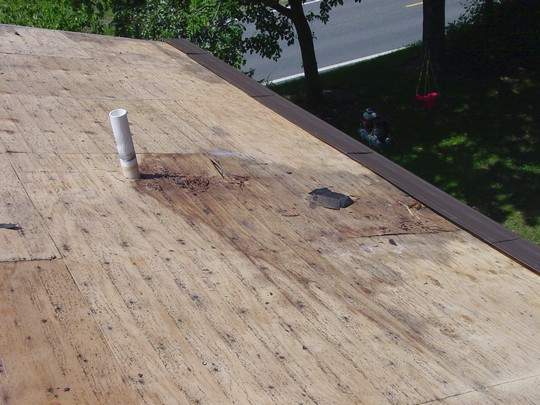
 Of course, roofs can leak, and we all know that the best material in the world is only as good as the contractor who installs it. You want to make sure you have someone experienced, who understands your home and knows the materials they're working with. The plywood under your roof can be damaged from a number of badly installed parts. For instance, the damage to the right was due to that pipe not being properly sealed, which allowed water in, which caused rotting to the roof and warping of the plywood beneath. It's never a pretty sight, and it's always traumatic to think that your home which provides so much safety and comfort to your and yours could be "that" house on the block.
Calling a licensed contractor is the only right way to deal with this issue. At your call, the contractor will have an experienced technician come out to your location, so that the problems can be fixed quickly.
Safety risks come from all directions. The toxic molds that were discussed in other posts on this blog love badly-installed roofs - the warm, dark area is an ideal incubator for that silent killer. Wind on a badly installed roof rips shingles off, and as more than one person has noted: strong winds are not always dangerous for the wind alone, the danger comes from what is carried along with it. Enough storms, with enough shingles ripped off, will cause a leak and damage your home. Moreover, if allowed to get in, rainwater can cause leaks down your walls (that's a part of why the molds are such a huge issue), but even down to your masonry foundations. In short: left long enough, a bad roof will cause a house to destroy itself. It's not a question of whether it will or not - only when.
We at Dream Team are GAF Certified, and any contractor you use should be too. They guarantee the quality of their material, and being certified means that our technicians know exactly how to install it in the best way possible.
Keep your roof in shape, and your home will always be a great place to live!
A good-looking roof is vivid in color and makes your home stand out against the rest of the neighborhood. A faded, old roof looks dilapidated, and generally makes your home look just old, stale, and tired. You don't want that - and you certainly don't want it when you go to sell!
Calling a licensed contractor is the only right way to deal with this issue. At your call, the contractor will have an experienced technician come out to your location, so that the problems can be fixed quickly.
Safety risks come from all directions. The toxic molds that were discussed in other posts on this blog love badly-installed roofs - the warm, dark area is an ideal incubator for that silent killer. Wind on a badly installed roof rips shingles off, and as more than one person has noted: strong winds are not always dangerous for the wind alone, the danger comes from what is carried along with it. Enough storms, with enough shingles ripped off, will cause a leak and damage your home. Moreover, if allowed to get in, rainwater can cause leaks down your walls (that's a part of why the molds are such a huge issue), but even down to your masonry foundations. In short: left long enough, a bad roof will cause a house to destroy itself. It's not a question of whether it will or not - only when.
We at Dream Team are GAF Certified, and any contractor you use should be too. They guarantee the quality of their material, and being certified means that our technicians know exactly how to install it in the best way possible.
Keep your roof in shape, and your home will always be a great place to live!
8/19/2012
Give your home a shower!
Power washing your home is big this time of year. It's nice and warm out, the skies look bright and cheery, and you want your home to look that much better. And, if you have aluminum or vinyl siding, like most of America, and certainly most of New Jersey and New York, you know that dirt sticks to it like glue, and with all of the environmental dangers to your home, you can be sure that at the beginning of the summer, your home is not looking at its best. So what options do you have?
You can't just go outside on a ladder with a steel wool pad - that's way too much work for anybody; and you're probably going to end up hurting yourself. So you hire a licensed contractor to power wash your home. Of all the work that can be done on the outside of your home, power washing is one of the best, for several reasons.
1. It's quick! Most power washings take less than two hours.
2. It's easy! All you do is call a contractor, and they should be able to start making your home look spotless in no time.
3. It's visible! As soon as the stream from the power wash hits your home, you'll start seeing that dirt and grime peel away, revealing the beauty beneath.
4. It's good for your home! It might be hard to believe, but that easy-as-pie power washing can help save your home from deadly and toxic black mold like you saw two weeks ago on this blog.
 Other parts of your home can benefit from this valuable service too. Wood decks take on a new shine and instead of looking tired and filthy, look like real healthy wood again. Look to the left over here. On the left, we have gray, weatherbeaten, foul-looking wood. Even walking across that deck wouldn't be as good. The one on the right looks warm and inviting, like a good solid wood deck. It's amazing what dirt and dust can do, if they're allowed to build up over time.
And other parts of your home, too, like masonry. So make your home look the best it can! Call Dream Team today for a free estimate on power washing.
You can't just go outside on a ladder with a steel wool pad - that's way too much work for anybody; and you're probably going to end up hurting yourself. So you hire a licensed contractor to power wash your home. Of all the work that can be done on the outside of your home, power washing is one of the best, for several reasons.
 |
| This is in the middle of the work, how amazing is that?! |
2. It's easy! All you do is call a contractor, and they should be able to start making your home look spotless in no time.
3. It's visible! As soon as the stream from the power wash hits your home, you'll start seeing that dirt and grime peel away, revealing the beauty beneath.
4. It's good for your home! It might be hard to believe, but that easy-as-pie power washing can help save your home from deadly and toxic black mold like you saw two weeks ago on this blog.

And other parts of your home, too, like masonry. So make your home look the best it can! Call Dream Team today for a free estimate on power washing.
8/12/2012
Keep cool! In your attic, at least
Hello again!
Most people know that heat rises. Most people also know that at the top of your home are usually asphalt shingles on top of wood - both of which absorb heat in your attic. And when your attic is hot, it comes down through your chimney, your walls, and into your living spaces. There are two ways to keep your attic cool - vents and fans. Ventilation is a passive process that causes cooler air to come into your attic and keep the hot air out. The image below can show you better than I can tell you. If you notice, not only is your attic a full 25 degrees cooler, your living space is actually 15 degrees cooler - naturally! And every degree you can cool naturally is one more degree that you don't have to cool with electricity.

Now, an attic fan is a more heavy-duty solution. As the name implies, it's a fan on the top of your house, that makes the attic even cooler still. As you can see, with a fan, it's even cooler than venting alone, and keeps your home cooler constantly.

And if you're worried about the energy draw of the attic fan on your home, there's a great solution: solar attic fans! With one of those in your home, you're not drawing any energy - in fact, you can sometimes give a little energy back to the grid - just like a regular solar panel on your roof. You're using the sun to cool your home, in a great "take that" to Nature!
Most people know that heat rises. Most people also know that at the top of your home are usually asphalt shingles on top of wood - both of which absorb heat in your attic. And when your attic is hot, it comes down through your chimney, your walls, and into your living spaces. There are two ways to keep your attic cool - vents and fans. Ventilation is a passive process that causes cooler air to come into your attic and keep the hot air out. The image below can show you better than I can tell you. If you notice, not only is your attic a full 25 degrees cooler, your living space is actually 15 degrees cooler - naturally! And every degree you can cool naturally is one more degree that you don't have to cool with electricity.

Now, an attic fan is a more heavy-duty solution. As the name implies, it's a fan on the top of your house, that makes the attic even cooler still. As you can see, with a fan, it's even cooler than venting alone, and keeps your home cooler constantly.

And if you're worried about the energy draw of the attic fan on your home, there's a great solution: solar attic fans! With one of those in your home, you're not drawing any energy - in fact, you can sometimes give a little energy back to the grid - just like a regular solar panel on your roof. You're using the sun to cool your home, in a great "take that" to Nature!
8/05/2012
Gutters: An essential part of your home.
I don't think our learned readers need a long-winded explanation of what gutters are. But, do you know the difference between a good gutter and a bad gutter? A good gutter protects your home from rain by funneling it away from your roof and into the downspouts. Bad gutters can fall into many categories:
So, what kind of danger are you in with bad gutters? Well, the word "extreme" comes to mind, in big flashing neon letters. Always remember this: your home's enemy number one, with a bullet, is water. Starting from the top, we have: danger to your roof and fascia. Wood & water do not mix in a way that's conducive to your home being a strong and safe place to live. Too much water will cause wood rot, which we'll talk about in more depth in a moment; and it also causes the wood to crack, especially if there is still water when the winter comes and things freeze up. If anyone remembers their science classes, you'll remember that water expands when it freezes - which can cause all sorts of warping and cracking effects on the wood under your roof and the fascia behind the gutter itself.
When you get past the roof itself, water from badly-installed gutters and downspouts can damage your walls, your foundations, and leak into your basement. Once it gets in there, there are a whole host of problems related to the wood rot.
So let's get to the nitty-gritty. The reason for the extreme danger is thus: mold. Water causes mold growth, and warm, dark, places like your roof and basement are the absolutely perfect places for it to grow. Why should you be worried about this? Because even the CDC says,
 And there are some very horrifying kinds of mold, like Black Mold. It will, if untreated, kill you. And while it's killing you, the water and the mold growth are eating away at the wood of your roof, the masonry foundations, and even your walls - in a few short years of mistreatment, your home can be completely unsafe and in fact, deadly for anyone to enter without a hazmat suit on.
Here's an extreme case - each of those polka-dot spots is really a colony of toxic black mold, spewing enough spores to kill a grown person:
And how do you prevent all of this? It's very simple. Twice a year, get your gutters flushed by a professional contractor like Dream Team. So save your home and keep dreaming safely, by calling us at (888)382-2001!
- Badly installed: If the gutters are set at the wrong angle, water will not flow properly to the downspout and runoff will occur at the wrong places.
- Too loose: If water cannot easily run to the gutter, or there is space between the gutter and the wall, there is a danger of water running down from the gutter into the siding - this is very dangerous to your walls and fascia boards. A gutter that pulls away can also do serious damage not only to the board behind, but also the roof it's connected to.
 |
| This is a gutter in real danger! |
- Clogged: Have you ever seen what happens after a beaver dam is built? That happens in your gutters; and if you have trees over them, they can even clog up with frightening regularity. And when it gets bad, if a seed, gets stuck in, something like the image to the right can happen!
- And still more.
So, what kind of danger are you in with bad gutters? Well, the word "extreme" comes to mind, in big flashing neon letters. Always remember this: your home's enemy number one, with a bullet, is water. Starting from the top, we have: danger to your roof and fascia. Wood & water do not mix in a way that's conducive to your home being a strong and safe place to live. Too much water will cause wood rot, which we'll talk about in more depth in a moment; and it also causes the wood to crack, especially if there is still water when the winter comes and things freeze up. If anyone remembers their science classes, you'll remember that water expands when it freezes - which can cause all sorts of warping and cracking effects on the wood under your roof and the fascia behind the gutter itself.
When you get past the roof itself, water from badly-installed gutters and downspouts can damage your walls, your foundations, and leak into your basement. Once it gets in there, there are a whole host of problems related to the wood rot.
So let's get to the nitty-gritty. The reason for the extreme danger is thus: mold. Water causes mold growth, and warm, dark, places like your roof and basement are the absolutely perfect places for it to grow. Why should you be worried about this? Because even the CDC says,
"In 2004 the Institute of Medicine (IOM) found there was sufficient evidence to link indoor exposure to mold with upper respiratory tract symptoms, cough, and wheeze in otherwise healthy people; with asthma symptoms in people with asthma; and with hypersensitivity pneumonitis in individuals susceptible to that immune-mediated condition. The IOM also found limited or suggestive evidence linking indoor mold exposure and respiratory illness in otherwise healthy children."
 And there are some very horrifying kinds of mold, like Black Mold. It will, if untreated, kill you. And while it's killing you, the water and the mold growth are eating away at the wood of your roof, the masonry foundations, and even your walls - in a few short years of mistreatment, your home can be completely unsafe and in fact, deadly for anyone to enter without a hazmat suit on.
Here's an extreme case - each of those polka-dot spots is really a colony of toxic black mold, spewing enough spores to kill a grown person:
And how do you prevent all of this? It's very simple. Twice a year, get your gutters flushed by a professional contractor like Dream Team. So save your home and keep dreaming safely, by calling us at (888)382-2001!
7/29/2012
Take it by the broad side!
You already know that your home has siding. And you know that keeping your home cool in the summer and warm in the winter is important to every homeowner. Not only do you look for comfort in your home, there’s also the energy bill throughout the year. The more of your home’s heat and ventilation you can see to naturally, the less you have to pay the power company for! And now that we're plunging headfirst into a beautiful summer here in metropolitan New Jersey, it's even more important.
Siding is like clothing for your home, too. Like your clothing, the condition of the house's siding can tell a lot about the people inside the house - especially if it looks discolored, warped, or damaged outright. You don't want to be "that" house, do you? No one does! So let's make sure you aren't!
 You can call a licensed contractor, like Dream Team, to come out to you home and give your siding a once-over. If all's well, but it's dirty, most contractors will suggest a power-wash, because that's all you need - that's part of what makes aluminum and vinyl siding so effective and so affordable. The difference can be astounding - go long enough, and it will sometimes look like a whole new house where the washer has done its job. Your neighbors will be inspired to brighten up their part of the neighborhood too when you do that. It's quick, it doesn't hurt anything, and it makes things look great - it's a win/win!
But sometimes the problems aren't so simple - or even surface level. Part of why we have siding is to keep your home's number one enemy, water, OUT of your home. Since it's summertime now, most of you know that stagnant water is a breeding zone for dangerous, disease-carrying insects like mosquitos. You also might realize that the dark and warm space between your home's outer walls and the siding can be an ideal growth medium for molds, especially dangerous ones like black mold - if that gets into your home, it can cause all sorts of illnesses and even cause small children to pick up asthma that will trouble them for the rest of their lives. And beyond that, I'm sure you've heard of the Grand Canyon - that just took water, and a lot of time. Your home is not so thick as that rock, and you definitely don't want any of that happening in the first place. If you do need new siding, your contractor will be able to discuss options with you, but will probably suggest either aluminum or vinyl. Both are pretty easy to upkeep, though vinyl has many advantages for a home. But, like going to a doctor, please talk to the contractor who comes to your home before making up your mind.
One of those great advantages is pretty simple: it's not hard to clean, and a simple power wash every few years will make it more than pay for itself in the years to come. It also provides a sealed side of your home and is capable of naturally repelling mold and mildew. Plus, it comes in a veritable rainbow of colors! Remember - bad siding is one of the first symptoms of a bad house; and no one wants to have a bad house.
Siding is like clothing for your home, too. Like your clothing, the condition of the house's siding can tell a lot about the people inside the house - especially if it looks discolored, warped, or damaged outright. You don't want to be "that" house, do you? No one does! So let's make sure you aren't!

But sometimes the problems aren't so simple - or even surface level. Part of why we have siding is to keep your home's number one enemy, water, OUT of your home. Since it's summertime now, most of you know that stagnant water is a breeding zone for dangerous, disease-carrying insects like mosquitos. You also might realize that the dark and warm space between your home's outer walls and the siding can be an ideal growth medium for molds, especially dangerous ones like black mold - if that gets into your home, it can cause all sorts of illnesses and even cause small children to pick up asthma that will trouble them for the rest of their lives. And beyond that, I'm sure you've heard of the Grand Canyon - that just took water, and a lot of time. Your home is not so thick as that rock, and you definitely don't want any of that happening in the first place. If you do need new siding, your contractor will be able to discuss options with you, but will probably suggest either aluminum or vinyl. Both are pretty easy to upkeep, though vinyl has many advantages for a home. But, like going to a doctor, please talk to the contractor who comes to your home before making up your mind.
One of those great advantages is pretty simple: it's not hard to clean, and a simple power wash every few years will make it more than pay for itself in the years to come. It also provides a sealed side of your home and is capable of naturally repelling mold and mildew. Plus, it comes in a veritable rainbow of colors! Remember - bad siding is one of the first symptoms of a bad house; and no one wants to have a bad house.
7/15/2012
Have you looked at your driveway lately?
Keeping in the spirit of this blog, we at Dream Team wish to point out another part of your home which you may not give a thought about on a regular basis: your driveway. Of course, you park your car on it to get it off the street. It also is a part of your home's appearance and curb appeal. You might not think about it very often, but your neighbors do - and chances are, it's the first thing people see when they come up to your home.
So you don't want it looking like this:
 Do you? Of course not!!
So you want to call a contractor who knows his stuff and can make your driveway look just right. And, here's a tip that you might not know: Call during the summer, while it's still hot. Your driveway's blacktop will spread better in the heat - less bumps, less air bubbles, insuring a longer, safer, lifetime for your driveway.
So, for service on your driveway or any other job in or around your home -
Call Dream Team today at 888-382-2001!
So you don't want it looking like this:

So you want to call a contractor who knows his stuff and can make your driveway look just right. And, here's a tip that you might not know: Call during the summer, while it's still hot. Your driveway's blacktop will spread better in the heat - less bumps, less air bubbles, insuring a longer, safer, lifetime for your driveway.
So, for service on your driveway or any other job in or around your home -
Call Dream Team today at 888-382-2001!
Subscribe to:
Posts (Atom)